Biosignal-Based Cognitive Modeling
What is Biosignal-Based Cognitive Modeling?
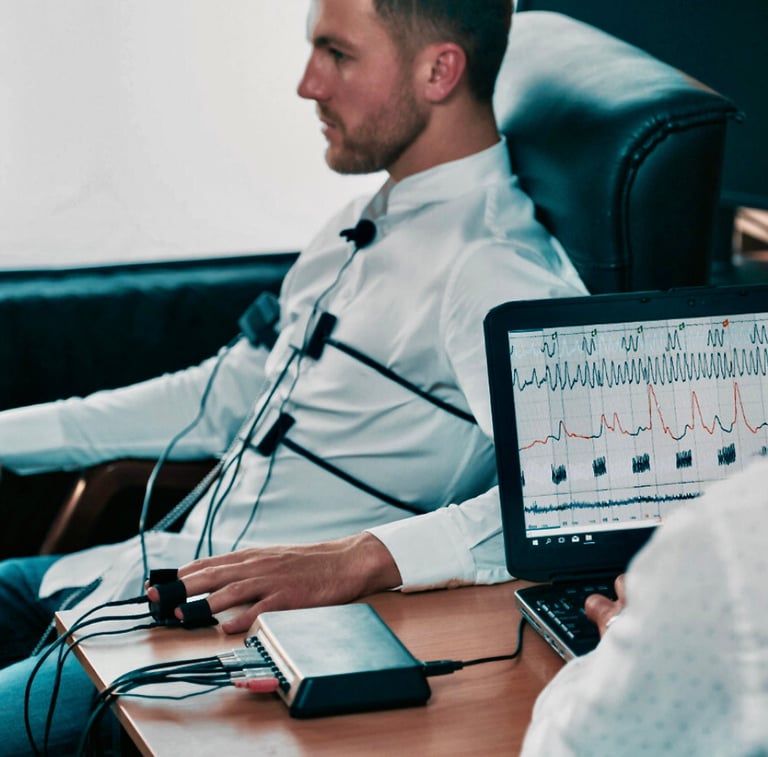
Biosignal-based cognitive modeling refers to the computational reconstruction of mental states - such as workload, vigilance, attention, or decision confidence - based on physiological and behavioral data. These models draw on real-time signals like EEG, EDA, respiration, heart rate, voice, or eye movement to infer cognitive conditions that are otherwise not directly observable.
In contrast to purely behavioral or declarative approaches, biosignal-driven models provide objective, real-time access to cognitive dynamics - even under conditions of high stress, time pressure, or degraded communication. They form the backbone of adaptive systems that support human performance in operationally demanding environments.

Our Expertise
HML has extensive experience in the development, validation, and operational deployment of biosignal-based cognitive models. Our methods are designed to ensure scientific reliability, practical relevance, and ethical integrity across all development stages.
Core capabilities include:
Experimental protocol design for cognitive state induction and measurement, including workload variation, stress exposure, and attentional demand manipulation
Multimodal signal acquisition and preprocessing, covering EEG, ECG, electrodermal activity (EDA), motion tracking, pupillometry, respiration, and voice analysis
High-dimensional feature engineering, extracting more than 5,000 features per channel via classical and brute-force techniques
Cognitive state inference through supervised learning, hybrid modeling, and explainable AI, enabling transparent and robust model behavior
Validation pipelines using behavioral baselines, task performance, and physiological ground truth, ensuring reliability and reproducibility across different contexts
Transfer learning architectures for cross-individual or cross-domain model generalization, enhancing adaptability and reducing calibration effort
Our modeling approach is explicitly designed for high-uncertainty environments, where fast, reliable, and adaptive cognitive estimation is mission-critical.
What We Offer
HML provides scientific and technical services for institutions seeking to integrate cognitive modeling into their systems, products, or research infrastructures:
Feasibility assessments for biosignal-based modeling in applied contexts, including operator monitoring, system adaptation, and candidate screening
Development of customized cognitive state classifiers, tailored to mental workload, vigilance, stress resilience, and related cognitive-affective states
Integration-ready modeling pipelines, encompassing feature extraction, signal fusion, model training, and seamless deployment into operational environments
Validation support in simulation or live settings, with pre- and post-measures, behavioral baselines, and task-linked model evaluation
Ethical consulting and data governance compliance, ensuring privacy-aware modeling, responsible biosignal use, and operational transparency
Our models are built for robustness, interpretability, and field applicability - designed not just to detect patterns, but to support mission-relevant decisions and system behavior.
Get in Touch
If you're considering integrating biosignal-based cognitive modeling into your operational systems, research platforms, or training environments, we would be delighted to support you. We offer non-binding consultations, partnerships for prototype development, and collaborative evaluation studies tailored to your specific requirements.
Address
Gustav-Poensgen-Straße 29
40215 Düsseldorf
Germany